
What to Expect from an Autism Assessment in Melbourne: A Guide for Individuals and Families
Autism assessments can look very different depending on where you go, the professionals involved, and the tools used. This can feel confusing, especially when the price varies so much between clinics.
At Better Together Therapy in Essendon, we follow up-to-date, evidence-based guidelines to ensure our autism assessments are comprehensive, neuroaffirming, and multidisciplinary. In this blog, we’ll walk you through what an autism assessment involves, why costs vary, and how our approach ensures clients feel supported every step of the way.
Why Are Autism Assessments Important?
An autism assessment provides more than just a diagnosis. It helps families, schools, and health professionals understand an individual’s strengths, differences, and support needs.
This knowledge is the foundation for:
Accessing the right supports and funding (e.g., NDIS)
Creating tailored strategies for school, home, and community
Reducing misunderstanding or mislabelling
Highlighting strengths and differences
Building understanding within the family unit
Earlier diagnosis is linked to less co-occurring mental health disorders
Why Do Prices for Autism Assessments Vary?
Individuals are often surprised by the variation in assessment costs. Here’s why:
Professionals involved: Some clinics use only a psychologist, while others (like us) have access to both psychologists and speech pathologists for a broader perspective.
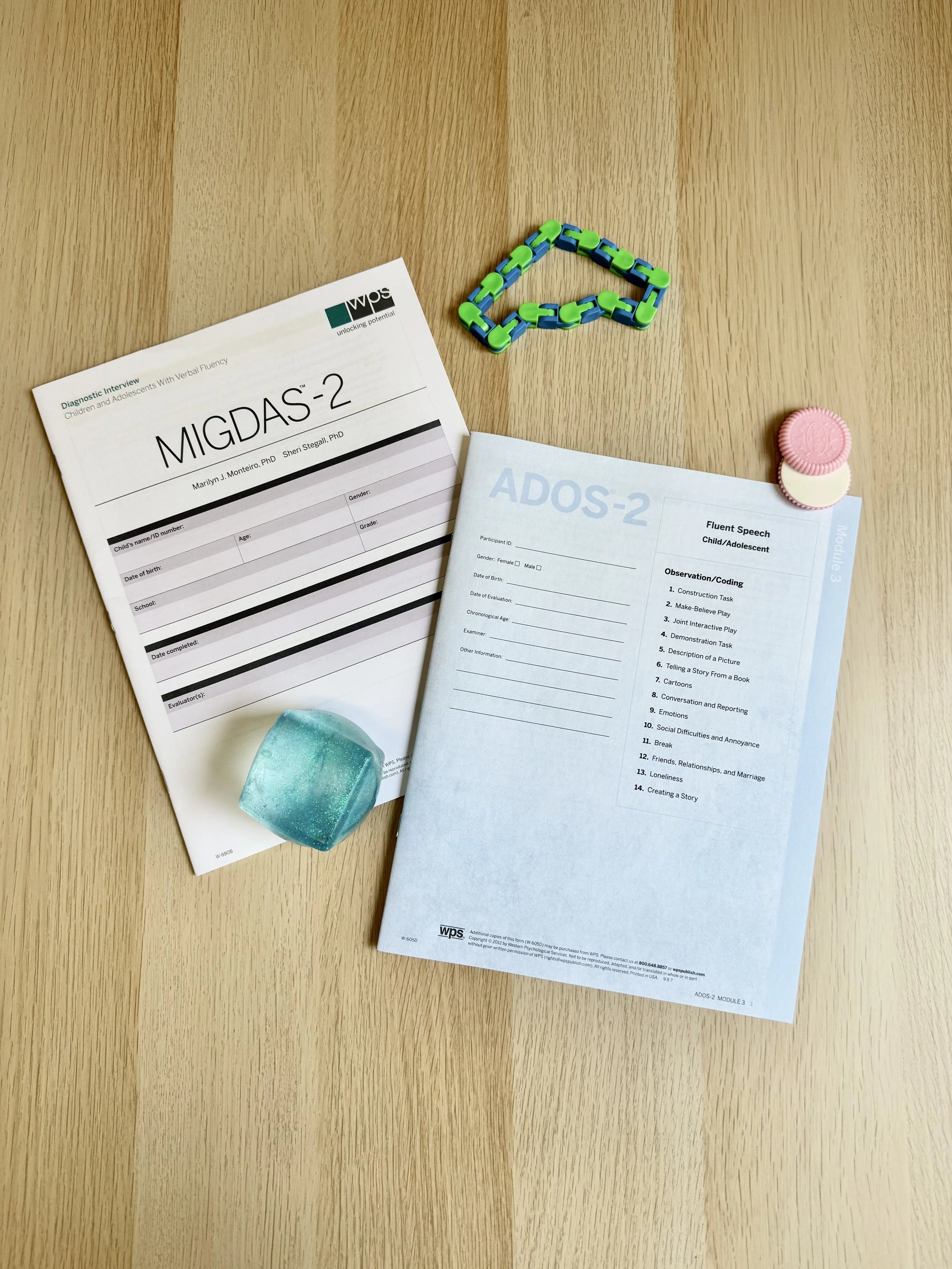
Assessment tools used: Evidence-based tools like ADOS-2 or MIGDAS-2 require specialist training and significant time to administer and interpret.
Depth of reporting: Some reports are brief (a few pages), while others are comprehensive with detailed recommendations.
Collaboration: A high-quality assessment involves liaising with schools, doctors, and other professionals, which adds time but ensures accuracy.
The takeaway? When comparing assessments, ask what is included, not just the price.
What Does an Autism Assessment Involve?
1. Comprehensive developmental history
We obtain detailed information about developmental milestones, communication, social interactions, sensory preferences, and daily life. This helps us understand the client’s journey from infancy to the present.
2. Standardised questionnaires
Questionnaires are provided to either the individual, parents/caregivers, teachers, friends or spouses. Examples of tools we may use include:
Social Responsiveness Scale (SRS)
Autism Spectrum Rating Scales (ASRS)
Camouflaging Autistic Traits Questionnaire (CAT-Q)
These provide insights into how behaviours present across different environments.
3. Direct assessment and observation
We use structured activities to observe how an individual communicates, plays, and interacts. Commonly used tools include:
ADOS-2 (Autism Diagnostic Observation Schedule, Second Edition)
A structured play and conversation-based tool that allows clinicians to observe social communication, interaction, and behaviours in a supportive settingMIGDAS-2 (Monteiro Interview Guidelines for Diagnosing the Autism Spectrum, Second Edition)
A narrative-based tool that captures personal experiences and lived perspectives from parents, teachers, and clinicians. It highlights strengths and differences, creating a rich, whole-person picture
Depending on the client’s age and needs, we may use one or both tools.
4. Cognitive and adaptive behaviour assessments
When appropriate, we complete assessments that look at problem-solving, learning, and daily living skills. This helps identify how an individual navigates both structured and unstructured environments.
5. Speech and language assessments (pragmatics)
Communication is a core part of an autism assessment. Our speech pathologists can explore pragmatics, which is how language is used in social contexts. This includes:
Understanding tone of voice, gestures, and facial expressions
Taking turns in conversations
Adjusting language depending on who you’re speaking to
Understanding humour, sarcasm, or figurative language
Because Better Together Therapy has both psychologists and speech pathologists in-house, our assessments can look at both the psychological and communication aspects of autism. This multidisciplinary model ensures nothing important is overlooked.
Please note: For adult autism assessments, pragmatics are typically assessed through the clinical interview and direct assessment
6. Collaboration with your care team
We liaise with your paediatrician, psychiatrist, school, or other allied health providers. This ensures a consistent approach across all settings.
Why Our Approach Is Different
At Better Together Therapy, our assessments are:
- Multidisciplinary: Psychologists and speech pathologists collaborate
- Neuroaffirming: We celebrate strengths and differences, not deficits
- Collaborative: Where appropriate, we will engage parents, spouses, friends, or teachers as key partners in the process
- Comprehensive: Detailed report and a 70-page handbook with psychoeducation and many resources
That’s right, our assessments include a detailed handbook. We created this because clients and families often told us that they felt “lost” after an assessment (when completed elsewhere). Now, clients will receive a report together with clear guidance and tools for the next steps.
Frequently Asked Questions
How long does an autism assessment take?
Assessments typically take several sessions across multiple weeks. This includes interviews, direct assessment, questionnaires, report writing, and feedback sessions.
At what age can someone be assessed for autism?
At our clinic, we offer autism assessments for children, adolescents and adults. For very young children (under 2–3 years), we may instead recommend developmental monitoring or early support, as profiles are still emerging and can change over time.
Will I (or my child) definitely get a diagnosis?
Not always. Sometimes the assessment reveals differences that don’t meet the full criteria for autism but still highlight areas where support would be beneficial. Either way, clients leave with helpful recommendations.
Is the report enough for NDIS?
Yes. Our reports meet requirements for NDIS access and funding applications, as well as school supports and medical referrals.
Final Thoughts
An autism assessment is more than a diagnostic process, it’s about creating a well-rounded understanding of an individual’s strengths and differences, and identifying supports that will help them thrive.
At Better Together Therapy, we’re committed to making this journey clear, collaborative, and supportive.
Ready to learn more? Visit www.bettertogethertherapy.com.au or contact our team today.
