
Do I Have AuDHD? Understanding Autism and ADHD in Adults

If you’ve ever felt like you were too much and not enough at the same time, you’re not alone. Maybe you crave structure but struggle to maintain it. Perhaps you’re deeply sensitive to noise and overwhelm, yet constantly seeking stimulation. You might hyperfocus for hours on something you love, while everyday tasks feel almost impossible to start. For many adults, these seemingly contradictory experiences are leading to a new realisation: they may be AuDHD.
What Is AuDHD?
AuDHD is an informal term used to describe individuals who are both autistic and have Attention-Deficit/Hyperactivity Disorder (ADHD). While the term itself isn’t a formal diagnosis, it reflects a growing understanding that these two neurodevelopmental differences frequently co-occur.
Historically, clinicians believed a person could not be diagnosed with both autism and ADHD. However, updates to diagnostic criteria and increasing research have highlighted significant overlap between the two. Today, it’s widely recognised that many individuals experience both, each influencing how the other presents.
Why Are So Many Adults Only Discovering This Now?
1. Changing Diagnostic Understanding
For many years, autism and ADHD were viewed as separate and mutually exclusive. As research has evolved, clinicians now recognise the high rate of co-occurrence between the two, leading many adults to revisit earlier diagnoses.
2. Masking and Camouflaging
Many individuals, particularly women and gender-diverse people, learn to “mask” their differences in order to fit social expectations. While masking can help someone navigate daily life, it often delays identification and contributes to burnout, anxiety, and a persistent sense of not quite fitting in.
3. Misdiagnosis and Diagnostic Overshadowing
Before recognising AuDHD, many adults receive diagnoses such as anxiety, depression, or personality disorders. While these experiences may be valid, they can sometimes overshadow underlying neurodevelopmental differences, leaving the root cause unexplored.
4. The Role of Social Media and Community Awareness
Platforms like TikTok and Instagram have played a significant role in increasing awareness of neurodiversity. Many adults encounter relatable stories that prompt them to seek professional guidance. While social media can’t replace a formal assessment, it has empowered people to start asking important questions.
5. Life Transitions That Expose Challenges
Major life changes (such as starting university, entering the workforce, becoming a parent, or experiencing burnout) can make previously manageable differences more noticeable, prompting individuals to seek answers.
The Unique Experience of AuDHD
Living with both autism and ADHD can feel like navigating opposing forces:
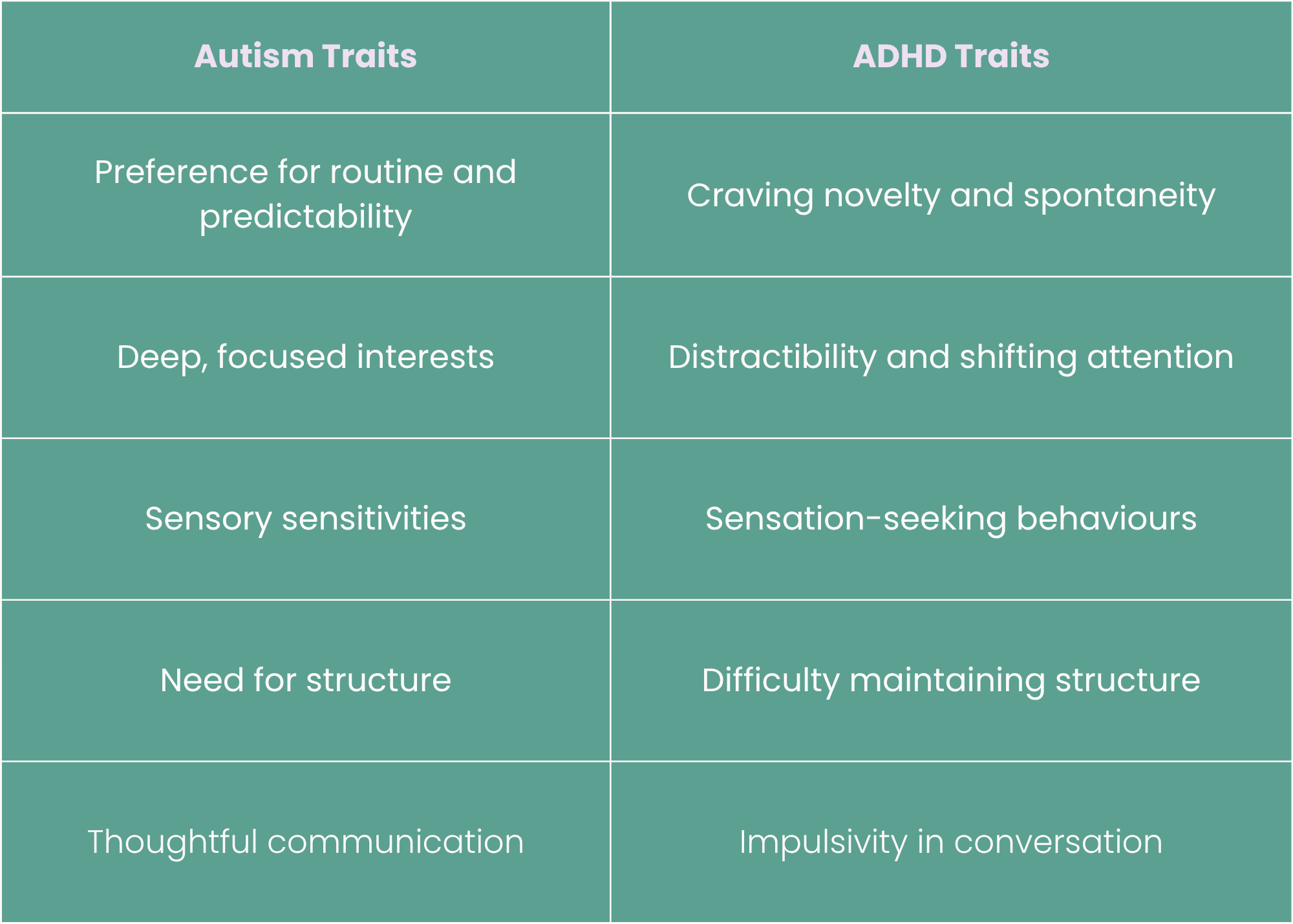
Rather than cancelling each other out, these traits often coexist, creating a complex and deeply individual experience.
Why an Assessment Can Be Transformative
For many adults, receiving an AuDHD assessment is less about obtaining a label and more about making sense of a lifelong narrative. It can:
Provide clarity and validation
Reduce self-blame and shame
Highlight unique strengths and abilities
Inform personalised strategies and supports
Open pathways to workplace or educational accommodations
Guide access to appropriate multidisciplinary care
Understanding both autism and ADHD allows for more tailored recommendations than considering either condition in isolation.
A Neurodiversity-Affirming Approach
At Better Together Therapy, assessments are grounded in a neurodiversity-affirming framework. This means recognising and celebrating differences while also providing practical support for areas of difference. Our comprehensive assessment process explores developmental history, current functioning, and individual strengths to ensure a holistic understanding of each person’s experience.
For many adults, discovering they are AuDHD brings a profound sense of relief:
“I’m not broken, I’m wired differently.”
“My struggles finally make sense.”
“I can start working with my brain instead of against it.”
This shift in perspective often marks the beginning of greater self-compassion, confidence, and empowerment.
Final Thoughts
If you’ve spent years wondering why life feels more complicated than it seems for others, exploring the possibility of AuDHD could be a meaningful step toward understanding yourself. You don’t need to be certain to start the conversation. Curiosity is enough.
Better Together Therapy is here to support you with warmth, expertise, and a commitment to helping you make sense of your unique neurodivergent profile, because understanding yourself is the first step toward thriving.
FAQ
Is AuDHD an official diagnosis?
No. AuDHD is not a formal diagnostic label. It’s an informal term used to describe someone who meets criteria for both Autism and ADHD. Clinically, these are still diagnosed separately, but it’s very common for them to co-occur.
How common is it to have both Autism and ADHD?
It’s actually very common, just often missed.
Research suggests around 30–50% of Autistic individuals also meet criteria for ADHD, which means many people are navigating both, even if they’ve only ever been identified as one.
Can Autism and ADHD mask each other?
Yes, and this is one of the biggest reasons people are missed or misdiagnosed.
ADHD traits (like impulsivity or novelty-seeking) can hide Autistic traits, while Autistic traits (like routine or rigidity) can mask ADHD. This can create a confusing clinical picture.
Why does AuDHD often get missed in childhood?
Because the traits can cancel each other out or present differently than expected.
For example, a child might appear “social enough” (ADHD) but still struggle with deeper social understanding (Autism), so concerns aren’t always picked up early.
Does AuDHD look different in girls and women?
Often, yes. Many girls and women are better at masking, which can make their traits less obvious. They may appear socially capable but feel exhausted, overwhelmed, or “different” internally.
What kind of support helps someone with AuDHD?
Support usually needs to address both profiles, such as:
Executive functioning support (ADHD)
Sensory and social understanding support (Autism)
Emotional regulation strategies tailored to both
A one-size-fits-all approach often doesn’t work.
If medication is considered, who needs to be involved?
If medication is something someone wants to explore, a paediatrician (for children) or psychiatrist (for adults) is required for assessment and prescribing. Psychology alone cannot prescribe medication but often plays a key role in assessment and ongoing support.
Is AuDHD something that needs to be “treated”?
Not in the traditional sense. AuDHD is a neurodevelopmental profile, not something to “fix.”
Support focuses on understanding the person’s brain, reducing distress, and building strategies that actually work for them.
